
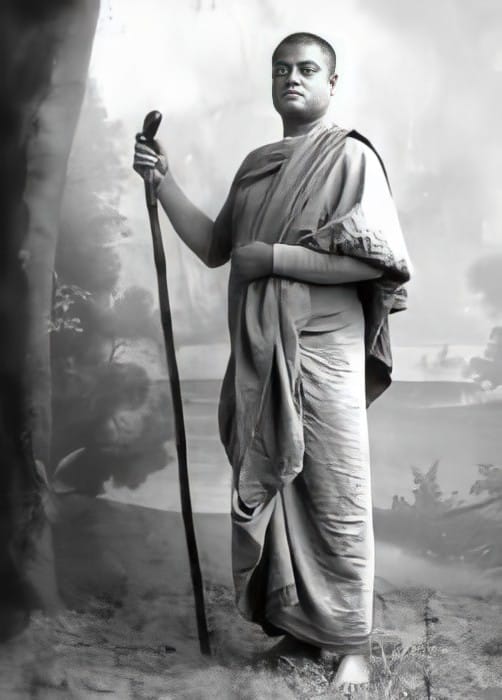
Vivekananda, as the name itself suggests, is the name of the man whose life narrates a life of awareness and bliss. In this present era of degeneration, when the Indian youth is lingering beneath the shadow of falsehood, corruption, and irrational ways of life, Vivekananda’s life and practices become a mantra, a therapy, to awaken the youth as pillars of the nation so as to take a step towards the making of a self-reliant India.
Vivekananda born in affluence chose a life of perseverance, discipline and simplicity. Swami Vivekananda's ancestral root takes us back to the village of Deretona in the Kalna subdivision of Burdwan district. Vivekananda’s ancestors had been living in this village since the Mughal period. According to many researchers, they were the landlords of that village. Lahering the Britishtwenty-fouridhi Dutta of that family, along with his son Ramjivan Dutta and grandson Ramsundar Dutta, moved to Garh-Gobindpur in Kolkata. They moved to the ShmemorisingShimla area of North Kolkata along with many others, when the construction work of Fort William College started. Around this period, Rammohan Dutta of this family (the grandfather of Vivekananda), built a house for himself at 3 Gourmohan Mukherjee Street. Durgaprasad Dutta, the eldest son of Rammohan Dutta, the grandfather of Vivekanacan nda, left the family and became a monk at the age of only 20. However, Vivekananda's father, Vishwanath Dutta, was born before that. Durgaprasad Dutta was a scholar of French and Sanskrit. His son Vishwanath Dutta was later brought up by his younger brother Kaliprasad. Kaliprasad was an Attorney of the Calcutta High Court. Later, Durgaprasad's son Vishwanath Dutta passed the Attorney examination in 1866 and was appointed to that job. Due to Kaliprasad's excessive spending, their family faced financial difficulties. But when Vishwanath Dutta worked as an Attorney, that prosperity was largely restored. Vishwanath Dutta was proficient in many languages. For example, he could speak Bengali, Persian, Arabic, Urdu, Hindi and Sanskrit. In addition, he was particularly well-versed in history and music and regularly read religious scriptures. He wrote two books - Sulochana (1880) and Shishtachar Sastra (in Bengali and Hindi, 1882). He publicly supported widow re-marriage which was promoted by Ishwar Chandra Vidyasinfluence onas a devout Hindu in terms of dress, food and manners; on the other hand, he followed the ways of the English in the premise of his profession. He led a royal lifestyle which was supported by his high monthly income. In addition, he gave shelter to many relatives and poor people. He was realisationhis ascepticism raising children; he taught his children to be self-reliant, while parallel he also taught them the basics of all religions. The children were also taught exercises, sports, singing, poetry recitation, and given physical training.
His wife Bhuvaneshwari Devi was the only daughter of Nandalal Basu of Shimla. Bhuvaneshwari Devi was a very radiant woman. As her manners and actions were marked by nobility, her heart was also very generous. It is said that no poor and unfortunate person would ever return empty-handed from her door. Every day she took care of all the household chores and along with them, performed daily pujas and prayers. She would regularly keep up with the news of the common people around the village. The death of some of Bhuvaneshwari Devi's children at a young age and her desire for a son, made her more religious and she performed daily pujas at the Kashi Vishwanath Temple. After that, on the day of Paush Sankranti on 12 January 1863, Narendranath Dutta was born, just 6 minutes before sunrise. Bhuvaneshwari Devi believed that the son was born by the grace of Lord Shiva, the Lord of Kashi, and so Bhuvaneshwari Devi named the child Veereshwar. Later, from this name, he was called 'Bilay'. Swami Vivekananda started learning English from his mother from childhood.
Both parents profoundly influenced the life of Narendranath Dutta in his boyhood. Since his childhood, he showed strong intellect, big heart, intense enthusiasm, indomitable courage, reckless attitude, interest in sports and games, friendliness and a strong inclination towards independent work. Along with these, the parents noticed that the boy Narendranath while playing had a strange habit of meditating in front of the idol of deities. Sometimes he would also play meditation with his friends. Driven by this strong spiritual thirst, he used to worship Ram-Sita and Shiva. Whether it was school sports, or, any other competition, he used to take the role of team leader. Whenever he saw saints and monks, he would run and talk to them. As Vivekananda grew and reached his adolescence, he showed more and more interest in reading various books. Meanwhile, he became quite proficient in music, and had also acquired very good skills in singing various ragas and bhajans. He started acting in plays from a young age. He was one of the front row audiences in Brahmo Samaj plays and prayer songs. Occasionally, he would go to Mahendralal Sarkar's Science Association, and attend lectures and have heated debates with his friends on the theories of literature and philosophy. Since childhood, he learned stick sports, horse riding, sword fighting, and also practised swimming, wrestling and gymnastics regularly. He was a real champion in boxing. He had read so many books since childhood that he started developing deep knowledge on many subjects; and this got reflected in his personality. Narendranath would also come forward first in the distress of any friend or common man. Deep friendship and compassion for the poor and the suffering were among the hallmarks of Narendranath's character traits. Parallel to his interest in saints and sages, he regularly practised astrology or astrological readings before sleeping at night. It appears the passion for the ascetic life was a hereditary tendency in Swami Vivekananda's family.
Swamiji looked a lot like his grandfather. That's why many people thought that Durgaprasad himself had been reborn through Vivekananda. From the age of 3, various complaints could be heard about Narendranath. He was very stubborn and could not be controlled very easily. Threats, scolding, and fear did not help. Everyone was kept at their heels due to Narendranath's naughtiness. That's why his mother would say, 'I had bowed and prayed and asked Shiva for a son, but he sent a ghost.' She would scold her son and say, 'If you misbehave, Shiva will not let you go to Kailash again.' Swamiji would immediately calm down. But when Narendranath was angry he lost the sense of good and bad. He would scatter and break the things of the house. Again, whenever he saw a monk, he would run to him. One day, Naren was playing with his friends in new clothes. At that time, a monk came to the house chanting 'Narayan Hari', 'Narayan Hari'. He asked for a dhoti. Naren immediately took off his dhoti and gave it to the monk. From then on, whenever any monk or saint came to the house, Narendranath was kept away; but it was difficult to stop him. He would throw whatever he had at hand at the monk through the window of the house. Hearing the story of Ramayana in his childhood, he developed a special respect for the characters of Ram and Sita. So one day, after saving some money, he went to the market with another boy, bought a pair of clay idols of Ram and Sita and started worshipping the Lord by hanging them in the attic of the house. Not finding Naren for a long time, everyone started searching. Finally, the door of the attic was broken and he was seen sitting in meditation in front of the idol. That day, thrashing by his guardians broke his meditation. Another incident happened some days later. Swamiji used to stay at times in the stable. At that time, he had a great friendship with the stable-manager. He considered the stable manager to be a man of great wisdom, and so he believed his words very much. One day, he heard from the stable manager that marriage was a great sin. Marriage brings quarrels and arguments in the household. Anger, quarrels, sons, daughters, poverty, hardship and many other problems arise out of it. The stable-manager put all these things into Narendranath's head. Swamiji immediately promised that he would never marry. But the problem was that he had heard from his mother that the love of Ram-Sita was incomparable. Their love was one of heavenly bliss and immense joy. From the stable-keeper he heard the opposite; so he went to his mother crying and told her about the incident. His mother smiled and said, "Biley, that’s not a matter of anxiety at all. You worship Shiva and Shiva will take care." After that, he immersed the idols of Ram-Sita and brought the idol of Shiva and meditated in front of it regularly.
He had the desire to become a monk since his childhood. When he was young, he would walk around wearing a piece of saffron cloth like a loincloth. Whenever his mother would say something, he would say, "I am dressed as Shiva." He had heard from the elders that if one meditated, a matted lock would come out of the head like that of a sage, and that lock of hair would go far into the ground like the roots of a banyan tree. So when he was young, he would meditate, and occasionally open his eyes to see if any lock was coming out and entering the ground. When he saw that the lock was not coming out, he would ask his mother, "I meditated, but where is the lock?" His mother would say, "Son, it cannot be done in half an hour, or even in a day; it takes many days." It is necessary to mention an incident related to meditation here. One day, he was meditating in a room with his friends, when suddenly a boy saw a huge cobra on the floor. Everyone except Swamiji screamed and ran away immediately. Despite calling Naren many times, they could not wake him up. So the news reached his home. The people of the house came and saw a terrible scene. The boy was meditating with his eyes closed, and in front of him was a huge cobra; but if they made any sound the snake could harm Naren, so they stood in silence and watched. After a while, Naren's meditation was broken when the snake left. Sometime later the snake left and Naren came out of his state of meditation. When asked about the incident, Naren said that he knew or perceived nothing.
From his childhood, Swamiji did not fall asleep as soon as he lay down like other boys. He used to sleep with his back up. In that state, whenever he closed his eyes to sleep, he would see a wonderful point of light between his eyebrows. That wonderful point would change into various colours and expand and gradually take a dome shape. Then suddenly it would burst like a firecracker and light would spread all around him. He would fall asleep drowned in that light. This was a daily occurrence. He thought that this happened to everyone, so he did not tell anyone. Then, when he started learning meditation from Debendranath Tagore, one day he asked one of his friends to find out how his meditation was going, "Well, brother, do you see a light before going to sleep?" But the boy could not understand his words. Swamiji had this kind of vision of light almost throughout his life. Sri Sri Ramakrishna Paramahamsadev, hearing about this vision of light, said, "This is a matter of perfect meditation." After a long time, he showed up for this visiton of Jyoti, or light, to one of his guru brothers. This vision of Jyoti was actually the result of deep meditation.
Narendranath was very stubborn since childhood. It was not possible to force him to do any work. Even with his eyes closed he could master any lesson by heart just by listening. From a very young age, he would excel in studies and sports, and in his play with his peers, he chose for himself the role of the king. He had a well-perceived clarity about caste discrimination from a very young age. In this regard, he used to say in his childhood, 'What happens if caste discrimination is not accepted? Will the sky collapse on people's heads or will people die?' He was a great lover of music since childhood. He was very familiar with various verses and especially with the verses from the Ramayana. He considered Lord Ramchandra as an ideal human. His mother told him many stories from the Ramayana and the Mahabharata. He first learnt the English alphabet and English vocabulary from his mother. Initially, Narendranath did not want to learn English as a foreign language. He said, 'Why should I learn that foreign language?' After much persuasion, he agreed to learn English. At the age of seven, he was admitted to the Metropolitan School. Regarding his childhood character, Swamiji himself told his disciples, "As a child, I was very fearless, otherwise, how would I be able to travel the world without a single paisa with me?"
Swamiji's mother Bhuvaneshwari Devi was very kind and gentle-hearted. At that time, a very poor Muslim family mortgaged their property to Swamiji's father and had to give the property to Swamiji's mother Bhuvaneshwari Devi as gift deed. The poor Muslim family could not repay the loan and came to Bhuvaneshwari Devi and requested earnestly. Seeing the plight of that family Bhuvaneshwari Devi immediately returned the property papers to that Muslim family. Swamiji had inherited his kind-hearted nature from his mother. Swamiji had been involved in many such incidents since his childhood which proves his kind-heartedness. He loved his friends more than his own life. He would not hesitate to help any neighbor, poor or suffering person . He never accepted the writings in the book or any word without proper rationale or judgment. In this regard, he said in his last the years of his life: "Do not accept anything as truth for the fact that it’s written in the book. Do not consider anything as truth because so and so person has said that. What truth really is, try to find for yourself." In this case, Swamiji was influenced by his father's wisdom, seriousness, power of judgment, epistemic ideology, and by the courage and morality that he inherited from his mother. Therefore, if to him, any teacher, or a person, or even his own father, did not seem reasonable, he would immediately oppose and attempted to establish his own opinion. In this regard, he did not want to accept Sri Ramakrishna Paramahamsa Dev as infallible at first. However, it was never blind opposition, but the belief in and thirst for, truth and justice. In his last life, Swamiji would often say, "He who doen’t worship his mother, can never truly grow or progress." Again, in another place he said, "I am indebted to my mother for the blooming of my knowledge." Swamiji's mother used to advise Swamiji- "Stay on the path of truth all your life, be pure, protect your dignity and never violate the dignity of others or interfere with their freedom. Remain calm but if necessary, make yourself firm in your determination." That is why Swamiji was very fearless and determined from a very young age.
Swamiji used to tell his mother Bhuvaneshwari Devi almost everything during his childhood. One day, while studying geography, a teacher started beating Naren severely because he had made a mistake. Swamiji repeatedly said that he had not made a mistake, but the teacher got even angrier and kept beating him with a cane. Swamiji silently endured all the beatings. After a while, the teacher realized that he had made a mistake and admitted his mistake to Swamiji. Swamiji went to his mother and told her about this incident. His mother consoled him and said, "My child, if you have not made a mistake, what does it matter? Whatever be the consequences, always do what you think is right. Sometimes you may have to endure unfair and unpleasant consequences for this, but still never divert from the path of truth." Swamiji, his entire life, followed this advice of his mother. For this, he had to endure a lot of suffering and torture. That is why Swamiji's famous saying is - "Everything can be sacrificed for truth. But truth cannot be sacrificed for anything." Also, Swamiji never forgot another piece of advice in his life. That is - "Never deviate from duty in life or in death." At the age of 14, while studying in the third grade at Metropolitan School, he went to Raipur in Madhya Pradesh with his father. While riding in a bullock cart, he was enchanted for the first time in his life by the beauty of the surrounding forests and flowers. While in Raipur, Swamiji was enriched intellectually by the company of his father Vishwanath Dutt and several other learned and virtuous people. The Metropolitan School authorities refused to admit him because he had been away for two years. Finally, he was admitted to the school with special permission. After that, he completed three years of study in one year and was the only one to pass the entrance examination of the Metropolitan School in the first division that year at the age of sixteen.
Then, on January 27, 1880, Narendranath's childhood games and mischief came to an end after he was admitted to Presidency College. In his first year, he contracted malaria and was decollegiated. Then he joined the General Assembly Institution, now the Scottish Church College. From this time on, he began to study literature, rhetoric, and philosophy with great interest. From then on, he worked hard to write, speak, and converse in English. He passed his F.A. in 1881 and passed his B.A. two years later. He studied so much during his college days that all the students and teachers were amazed; that is why the Principal of the college, William Hastie, said-"Narendra Nath Dutta is really a genius! I have travelled far and wide, but I have never yet come across a lad of his talents and possibilities, not even in the German Universities, amongst students of Philosophy. He is bound to make a mark in life." Surendranath Bandopadhyay heard his lecture at the Metropolitan School. A few days later he said about Swamiji- "He is the greatest public orator India had ever known.” The biggest change in Narendranath's life took place when his age was between eighteen and twenty four. He had a clear idea about education. Regarding examinations, his opinion was- "Examinations are nothing, passing is not the purpose of life. And memorizing for the sake of passing is just a misuse of memory." In this regard, he further said,- "The aim of today's student generation is not to gain knowledge, and so I find them quiting studies as soon as they get a degree. The students of this country should have a very clear idea of what real knowledge is, what its purpose is and how far can it influence ones character." He remained steadfast in this belief till his last days. While studying in college, he had a strong passion for Mathematics, Higher Mathematics, Astronomy as well as, Sanskrit grammar and Bengali language. Swamiji, who had a strong memory, could remember anything exactly after hearing since his childhood. He had always been interested in history. He studied Green's History of the English, Alison's History of Europe, Gibon's Decline and Fall of the Roman Empire as well as Wordsworth's poetry and Herbert Spencer's obscure philosophy, Kant, Schopenhauer, August Comet, John Stuart Mill, Aristotle in depth, because he realized that it is not possible to explain the true theory of Hinduism to the opponent without a thorough study of all the philosophical doctrines of the world.
While studying in college, after reading the books of Western philosophers, Narendranath had doubts about agnosticism or the existence of God. Especially Spencer's book The Science of the First Principles had an influenced Swamiji to a little extent. Under its influence, he abandoned his blind faith in the priestly class and decided to stand against their dominance and also against the blind faith of the people, which had distorted the religious life of the whole of India. In Swamiji's character, spiritual realization and skepticism coexisted. This dual perception remained with him until the death of Sri Ramakrishna Paramahamsadev. That is also the reason that made him test Sri Ramakrishna in various ways for about 5 years, after meeting him. Swamiji advanced on the path of truth by fighting with doubts and disbelief. He read the works of Rammohan Roy. He agreed with the orator Keshav Chandra Sen on several things about Brahma Dharma. He had registered himself as a member of the Brahmo Samaj. Just as he had taken meditation lessons from Maharishi Debendranath Tagore, he questioned the Maharishi with a skeptical mind. Even though he visited the Brahmo Samaj, he never considered himself anything other than a Hindu. At the same time, he never indulged in the narrow-mindedness of the Hindu society.
Swamiji wanted to become a preacher like Keshav Chandra Sen by joining the Brahmo Samaj. Swamiji thought that despite being endowed with unparalleled wealth, Maharishi Debendranath lived a life of sacrifice, yearning for peace and truth, and spent most of his time in meditation. When he was attracted towards Keshav Chandra Sen’s religious path and developed his inner power eventually, Swamiji thought that all his goals would be achieved by going to him. So after learning meditation for a while, one day, he asked the Maharishi, who was meditating on a boat floating on the Ganges, "Have you seen God?" The Maharishi tried to give a proper answer to the question, but Swamiji did not like it. Prior to this, Swamiji had had his first meeting with Paramahamsa Dev in 1881 at the house of Surendranath Mitra. Then one day, along with Surendranath Mitra and several others, he went to Dakshineswar to meet Paramahamsa Dev. From then on, Swamiji's closeness with Paramahamsa Dev continued to grow, and after testing and examining Thakur at every step for five long years, he finally reached a firm belief and accepted Paramahamsa Dev as his guru.
Swamiji believed in the Upanishads' saying - "Na Prajaya Na Dhanen Tyagenaike Amritattava Manashuh", that is, Amrit or True enlightenment can be attained not through children or wealth, but only through sacrifice. That is why he said that India has never sought wealth. Despite possessing vast wealth, that is more than any other country or nation in the world, India has never been greedy for wealth. According to him, the purpose of India's national life was never political or military. That is why Swamiji asked the youth of India to be strong. He said- "Be strong, my young friends, and, this is all I have to say to you. Playing football will take you closer to God than reading Gita. I am saying these words very firmly and boldly; but what else can I do other than saying it, for I have to. I love you. I know what the problem is - where the thorns are pricking. I have some experience. I tell you, if your body is stronger, you will understand the Gita better. If your blood is a little fresh, you will be able to perceive the greatness, virtue and strength of Shri Krishna. When your body is firmly supported by your feet, when you can feel yourself as a true human being, then only you will understand the greatness of the Upanishads and of the soul better." Later we saw that many intellectuals, including those from the Left, have spread the false propaganda that 'Swamiji has advised playing football instead of reading the Gita.' Contrary to the Leftist propaganda, as is clear from the quotation from Swamiji, he had asked the youth to do regular physical exercise to strengthen their bodies and mind because a great mind can only bloom in a healthy body; with a weak body and mind one can never do any great work, one can never understand the vision and virtue of the Indian philosophical world and its relevance as is to be found in the religious and spiritual text like Gita and the Upanishads. So the youths are encouraged to learn stick martial art, wrestling, swimming, and play football. He advised the youth to keep their mind focused and nervous system calm through regular yoga and pranayama. The youth should move like heroes. They should overcome fear and weakness and become strong, so that strength is felt in every vein of the body. He said- "If I had a son, as soon as he was born I would start telling him, 'Tamasi Niranjanah'."
Swamiji has asked the youth to gain virility and has told the way to get it. He has asked them to believe in the Upanishads - "I am the soul, the sword cannot cut me, no instrument can pierce me. Fire cannot burn me, air cannot dry me, I am omnipotent, I am omniscient." He has always warned the youth against thinking of themselves as weak. Therefore, he had always instructed them to eat sattvic and nutritious food. He advised them to eat pulses, bread, ghee, vegetables. He had also advised the youth to eat non-vegetarian food according to the situation to increase their energy. He directed them to eat in moderation and avoid excessive food. He had asked the youth to stay strictly away from all kinds of intoxicants. Drugs destroy our vitality. He was against eating foods that create aggression in us. Therefore, he had instructed the youth to observe celibacy. Swamiji believed that the secret key to the indomitable talent and strength of Indian youth is Brahmacharya, and this he called 'Ojah Shakti'. Therefore, he advised them to get up early in the morning before sunrise and practice prayer or meditation. By practicing this, the nerves and brain become strong. When the nerves and brain are strong, fear and weakness are removed from the mind. Swamiji believed that fear and weakness are the root cause of all sins and degradation. He wanted the body of the youth to be as strong as iron, the nerves to be as tough as steel. The minds of the youth should be focussed and pure. The character of the youth should be founded on sacrifice and truth; and so he was of the opinion that it was absolutely necessary to believe in Brahmacharya and the Upanishads.
Swamiji believed that the future of the present self-reliant India lies within our youth. Therefore, he asked the youth to be firm and confident. He said that in ancient India, those who did not believe in God were atheists. In modern India, those who do not believe in themselves are atheists. In 'Lectures from Colombo to Almora', he said to the youth, 'Uttistha Jagrata Prabhi Varana Nibodhat' meaning “Arise, awake, and do not stop till the goal is reached.” And so, the youth should focus on character building. They should focus on human building, and not just on textbook knowledge. Selfless service of the youth can make a nation extremely prosperous.
Swami Vivekananda wanted to build a new India based on the famous saying of Paramahamsa Dev, 'Serving life with the knowledge of Shiva'. We believe that this message of Swami Vivekananda is absolutely essential for building a self-reliant India and elevating India to the position of Biswaguru, the true teacher of the world. Therefore, the youth of today should follow the ideals and instructions of Swami Vivekananda and participate in building a prosperous modern India that is humane, progressive, rational, yet rooted in a religion, in a tradition that disseminates the knowledge of virtuous living.
Reference book
1. The Complete Works of Swami Vivekananda, Mayavati Memorial Edition, Vol no I, tenth (enlarged Edition, 1997, published by Swami Gambhirananda, Advaita Ashrama, 4 wellington lane, Calcutta- 13)
2. Complete works of Swami Vivekananda, 1 - X volumes, 34th reprint, Paush, 1419, Publisher – Swami Mumukshananda, Inauguration Office, 1 Inauguration Lane, Baghbazar, Kolkata-003.
3. My India is the immortal India, Swami Vivekananda, Ramakrishna Math and Ramakrishna Mission, Belur Math, Kolkata-14.
4. Swami Vivekananda's Biography, Shri Pramathanath Bose, Publisher - Brahmachari Ganendranath, Inauguration Office, 1 No. Mukherjee Lane, Baghbazar, Kolkata - 003.
(This article was written by Dr. Biswajit Roy during the occasion of National Youth Day, 2026)